

Modern urban environments use various visual and tactile elements to warn pedestrians about potential dangers. Among them, yellow tactile tiles and contrasting yellow warning lines have a special role. They are already used in many countries and are primarily intended to help visually impaired and blind people. For the Smombie Assistant project, these elements are particularly interesting because they can serve not only as existing pedestrian safety features, but also as visual indicators for automatically detecting potentially dangerous areas.
Yellow tactile paving
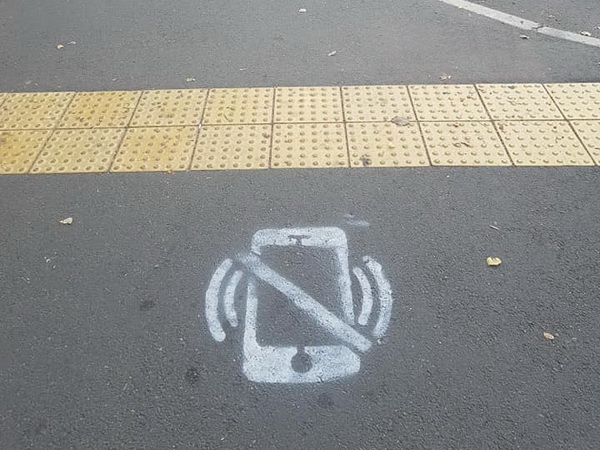
Yellow tactile paving, also known as tactile tiles, tactile pavement, Braille blocks, or Tenji blocks, are special tiles with a raised surface. They are used to warn visually impaired and blind people about dangerous changes in the surface, obstacles, and slopes, and also help them navigate their surroundings. Today, such tiles are used in many countries around the world, and in some of them their use is already close to being standardized.
For Smombie Assistant, yellow tactile tiles could serve an additional function as a warning sign for a person who uses a smartphone while walking. Because such a pedestrian's attention is focused on the screen, they may fail to notice a dangerous area directly ahead. The smartphone camera could detect the characteristic yellow color and raised structure of the tiles, after which Smombie Assistant could warn the user about the danger. In this way, an existing element of urban infrastructure could simultaneously help visually impaired and blind people and automatically warn pedestrians who use smartphones.
Yellow warning lines
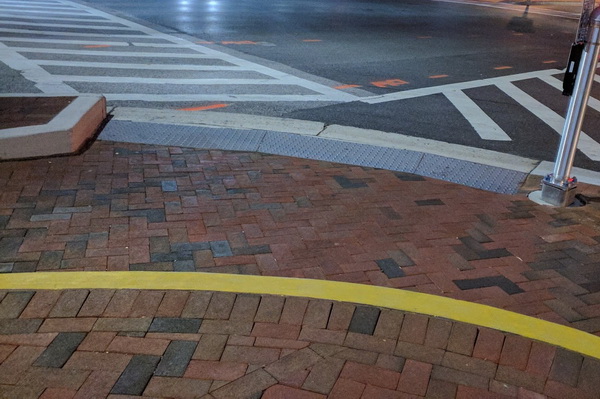
Yellow warning lines are contrasting strips of yellow or orange color used to mark the boundaries between dangerous and safe areas. Such lines are widely used in different countries as visual warnings for pedestrians. They can be found in public places such as public transport stops, metro stations, near pedestrian crossings, stairs, and along the edges of steps and curbs. Thanks to their bright color and contrast with the surrounding surface, they are clearly visible even at a quick glance.
For Smombie Assistant, yellow warning lines could become another reference point for identifying potential danger ahead of a pedestrian. Unlike analyzing the entire surrounding environment, the module would not need to recognize every object in front of the person. It would only need to first detect the characteristic yellow color and then analyze the shape and position of the detected line. If its characteristics match those of a warning sign, Smombie Assistant could notify the user about the danger. Sending anonymized information about such events to SmombieNET could later make it possible to combine data from different users and identify locations where similar warnings occur most frequently.
Conclusion
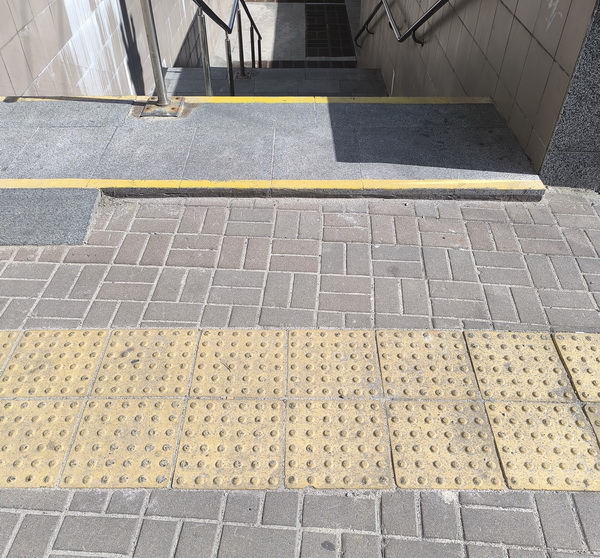
Yellow tactile tiles and yellow warning lines are already part of urban pedestrian safety systems. Their use in the Smombie Assistant concept makes it possible to avoid creating a new system of visual signs specifically for smartphone users and instead use existing and highly visible elements of urban infrastructure. This approach could simplify the detection of dangerous areas, reduce the requirements for analyzing the surrounding environment, and at the same time connect individual warnings from Smombie Assistant with the SmombieNET system, which could use the accumulated data to analyze pedestrian and urban infrastructure safety.